
Amazon Nova Explores Self-Distilled Reasoning for Fine-Tuning
Summary
Amazon Nova researchers are investigating Self-Distilled Reasoning (SDR) to generate 'thinking tokens' for datasets lacking explicit reasoning traces in supervised fine-tuning. This technique aims to address the reasoning suppression problem and has been validated across three benchmarks, with practical recommendations provided.
Why it matters
This research offers a method to improve the reasoning capabilities of fine-tuned AI models, particularly when training data lacks explicit reasoning steps, which can lead to more robust and explainable AI systems.
How to implement this in your domain
- 1Investigate the Self-Distilled Reasoning (SDR) technique for custom model fine-tuning projects.
- 2Experiment with generating synthetic reasoning traces for proprietary datasets that lack explicit thought processes.
- 3Apply SDR to improve the interpretability and performance of models in tasks requiring complex reasoning.
- 4Review the practical recommendations provided by Amazon Nova for integrating SDR into existing SFT workflows.
Who benefits
Key takeaways
- Self-Distilled Reasoning (SDR) generates 'thinking tokens' for SFT datasets.
- SDR addresses the reasoning suppression problem in AI models.
- The technique has been validated across multiple benchmarks.
- Practical recommendations are available for implementing SDR.
Original post by Rushil Anirudh
"In this post, we explore an idea for generating thinking tokens for datasets that lack reasoning traces in SFT customization. We first examine the reasoning suppression problem, then introduce Self-Distilled Reasoning (SDR), validate it across three benchmarks, and provide practi…"
View on XOriginally posted by Rushil Anirudh on X · view source
Want to go deeper?
Turn these trends into skills with Learnijoy's hands-on AI & tech courses.
Explore coursesMore in AI Research

New Research Explores AI Reward-Seeking Behavior and Measurement
New research with Apollo AI Evals investigates "reward-seeking" in AI models, where models prioritize grader rewards over user intent. They introduce Contrastive SDF, a new method to measure how strongly these beliefs about grader preferences shape model behavior, which is crucial for generalization.
Poolside and Laguna Advance Open Model Development in the West
Poolside and Laguna are actively contributing to the development of open models, with a "model factory" approach that aims to release new models frequently. This effort is highlighted as crucial for Western leadership in the open-source AI space.
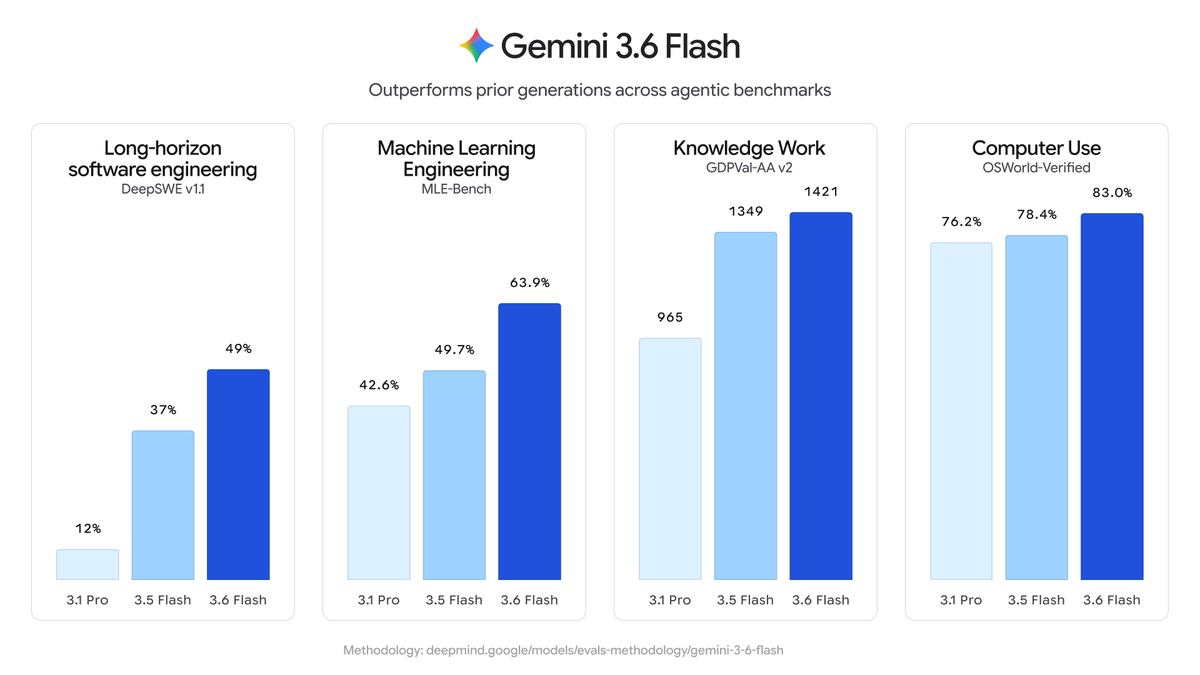
Gemini 3.6 Flash Improves Code Generation and Multimodal Tasks
Gemini 3.6 Flash, an iteration building on 3.5 Flash feedback, shows significant improvements in code generation, producing production-ready code faster and avoiding loops. It also excels in multimodal tasks like chart analysis, document understanding, and report drafting, and is rolling out across Gemini App and developer platforms.