
Gemini 3.6 Flash Improves Code Generation and Multimodal Tasks
Summary
Gemini 3.6 Flash, an iteration building on 3.5 Flash feedback, shows significant improvements in code generation, producing production-ready code faster and avoiding loops. It also excels in multimodal tasks like chart analysis, document understanding, and report drafting, and is rolling out across Gemini App and developer platforms.
Why it matters
For developers and professionals relying on AI for coding and data analysis, an improved model like Gemini 3.6 Flash offers tangible benefits in terms of efficiency, code quality, and the ability to handle complex multimodal inputs.
How to implement this in your domain
- 1Experiment with Gemini 3.6 Flash for code generation tasks to improve development speed.
- 2Utilize its multimodal capabilities for analyzing data in charts and documents.
- 3Integrate 3.6 Flash into workflows for automated report drafting and content summarization.
- 4Explore its API access in Google AI Studio and Android Studio for custom application development.
Who benefits
Key takeaways
- Gemini 3.6 Flash improves upon 3.5 Flash with better code generation.
- It produces production-ready code faster and avoids loops.
- The model excels at multimodal tasks like chart analysis and document understanding.
- It is available in the Gemini App and for developers via APIs.
Original post by @GoogleDeepMind
"Gemini 3.6 Flash builds directly on feedback from 3.5 Flash. Watch how it compares on quality and token usage ↓ It’s much better at writing production-ready code faster without getting stuck in loops. Plus, it excels at multimodal tasks like analyzing charts, understanding docume…"
View on X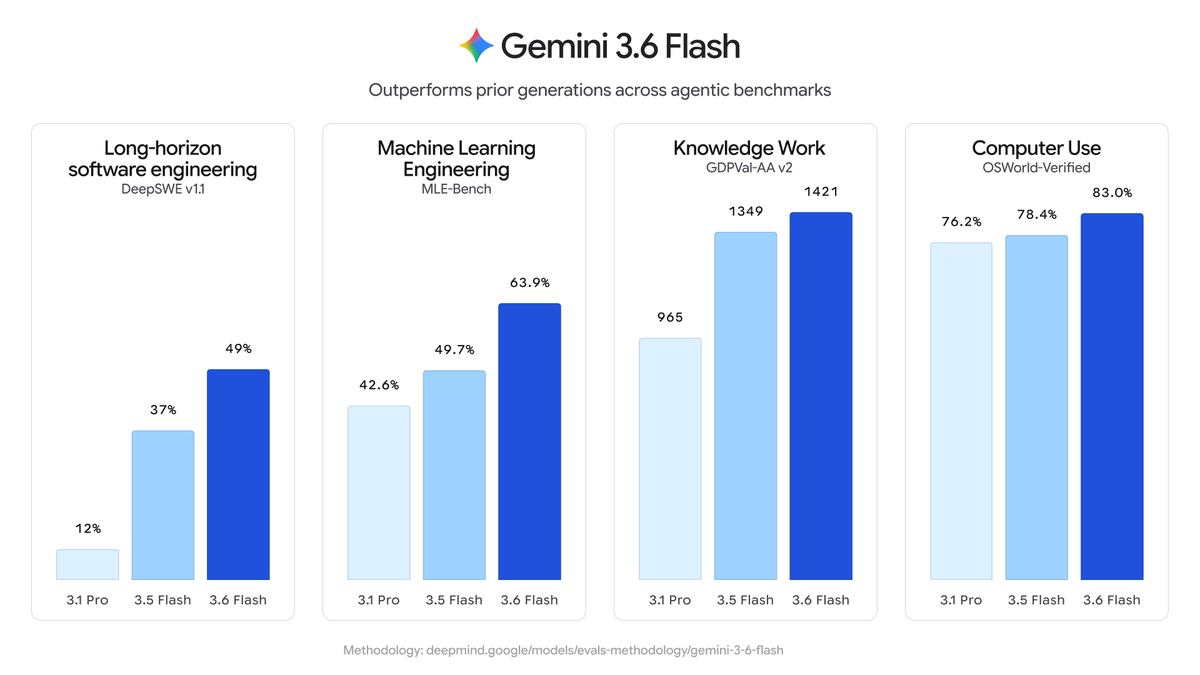
Originally posted by @GoogleDeepMind on X · view source
Want to go deeper?
Turn these trends into skills with Learnijoy's hands-on AI & tech courses.
Explore coursesMore in AI Engineering & DevTools

New Research Explores AI Reward-Seeking Behavior and Measurement
New research with Apollo AI Evals investigates "reward-seeking" in AI models, where models prioritize grader rewards over user intent. They introduce Contrastive SDF, a new method to measure how strongly these beliefs about grader preferences shape model behavior, which is crucial for generalization.

Thesean Launches Ship, Potentially Halving AI Model Costs
Thesean has introduced "Ship," a new offering that claims to provide the same capabilities and behavior as high-end models like Opus 4.8 and GPT-5.6 Sol at potentially half the cost. This could significantly reduce operational expenses for AI deployments.

Alibaba Launches Qwen-Image-3.0 with Advanced Image Generation
Alibaba's Qwen has released Qwen-Image-3.0, a new image model featuring a 4.5k prompt input limit, world knowledge integration, and multilingual, long text rendering. While public benchmarks are pending, initial examples showcase impressive capabilities like multi-panel grids and realistic document generation.